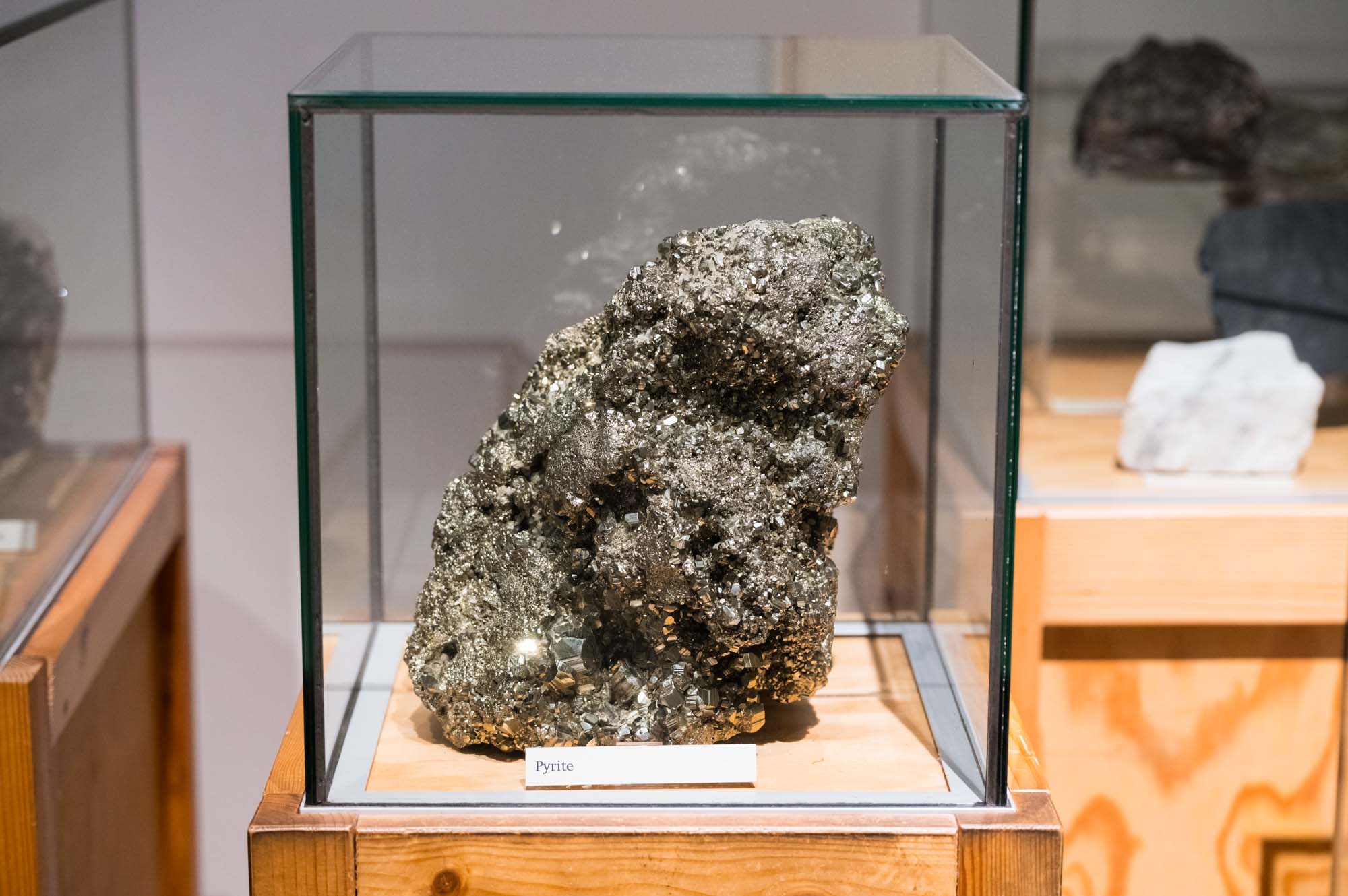


Pyrite, also known as 'Fool’s Gold', is a mineral that possesses a metallic lustre. Due to the mineral’s gold coloured appearance, it is often mis-identified as gold. However, it is not a metal, but a mineral. It has a brittle composition and can break under pressure, unlike gold which bends or dents. Its colour is different from gold, with a brassy-yellow appearance.
Pyrite most commonly occurs in a distinct cubic shape, often with characteristic parallel lines on its faces. The main deposits are in Peru, Italy, Greece, Spain, the United States, Mexico, China and France. It has also been found in meteorites that have fallen to Earth. This suggests that pyrite may be common throughout our solar system, and perhaps even beyond.
The name pyrite is derived from Greek word pyr, - 'fire', as it emits sparks when struck by steel. Nodules of pyrite have been found in prehistoric burial mounds, which suggests their use as a means of producing fire. Pyrite remains in commercial use to produce sulphur dioxide for the paper making industry, and in the manufacture of sulfuric acid.
- This object was chosen by Binyam
- He is originally from Eritrea
- His favourite object was the Pyrite
“I have seen those stones in my country, and it made me think of home”.