

Until the 18th Century people did not know where meteorites came from. It was commonly believed that meteorites were formed from either lightning strikes, or volcanic debris that accreted in the air into large, rocky masses that then fell to Earth. On 13 December 1795, a meteorite fell in an agricultural field near the village of Wold Newton in East Yorkshire. With no active volcanoes anywhere near Yorkshire, this seemed an unlikely explanation.
Before the Wold Cottage meteorite fell, German physicist Ernst Chladni (1756-1827) had begun recording similar events. In 1794 he published a book in which he suggested that the unusual rocks had extra-terrestrial origins. The Yorkshire stone prompted the first full scale investigation into the origins of meteorites. Notable naturalist Sir Joseph Banks began a worldwide study to compare them. Scientists now know that meteorites have extra-terrestrial origins. Many come from asteroids, but we also get meteorites from the Moon and Mars.
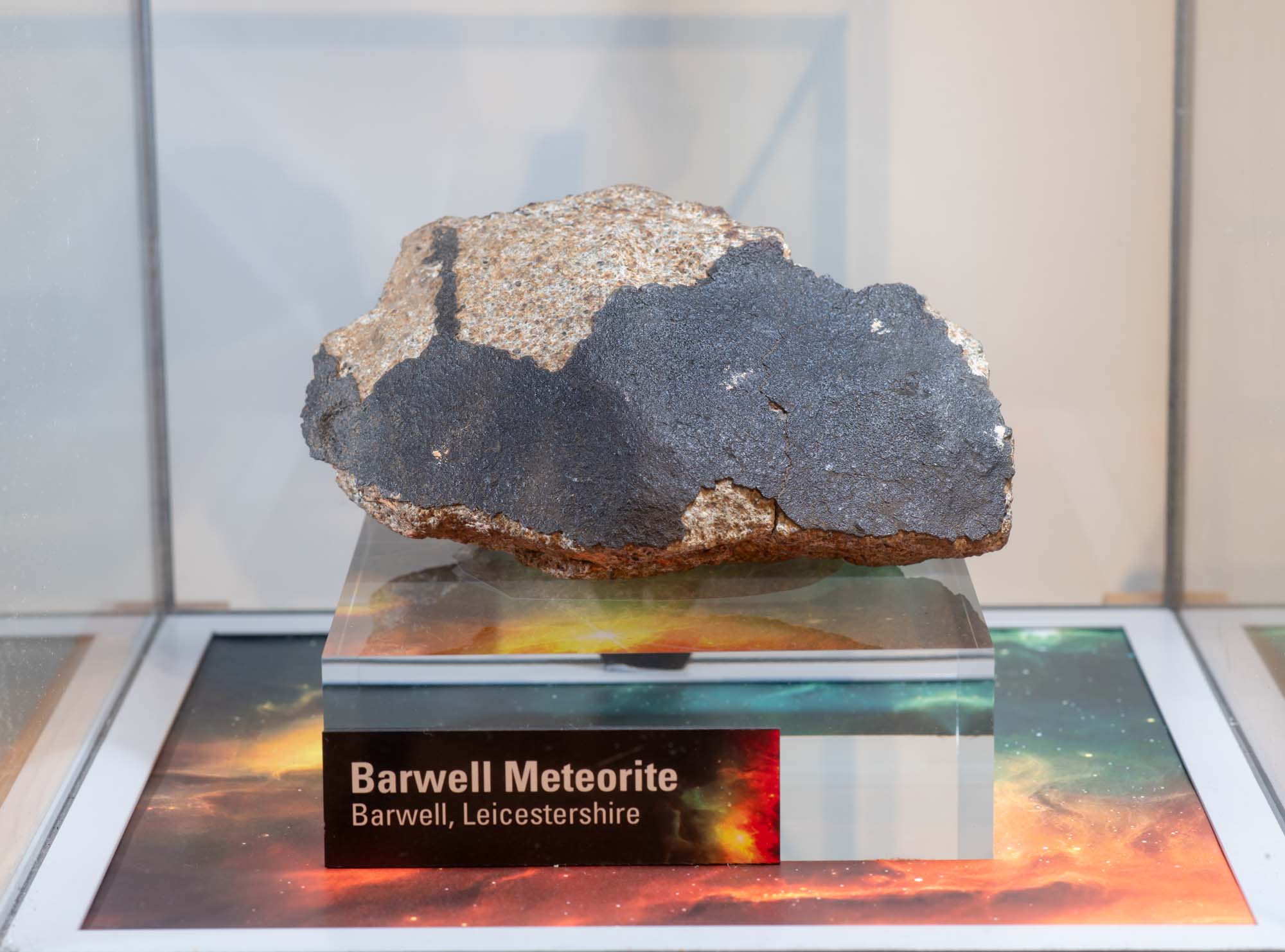
On Christmas Eve 1965 residents of southwest Leicestershire saw a fireball streaking across the sky. This Barwell meteorite broke into multiple pieces. The largest fragment, weighing about 2.2kg, was acquired by the Museum from Mr Harold Platts, who found it on his allotment while picking some Brussel sprouts.
- This object was chosen by Abraham
- He is originally from Eritrea
- His favourite object was the Barwell Meteorite
“I’m interested from the astrometry aspect. Interested to find out that it existed before the Earth”.