


While we do not know what the British and Romans called it, Evington’s modern name has clear Anglo-Saxon root, for in the 8th century the area was known as “Aefa’s Tun”.
This became “Avintone” by the Norman Conquest. In 1086, the Domesday Book census recorded that the village comprised of thirty-seven households. Its population comprised of twenty-five heads of a household, two smallholders, six enslaved persons, and an uncounted number of women, children, and older people. This put it in the largest 20% of settlements recorded at Domesday.
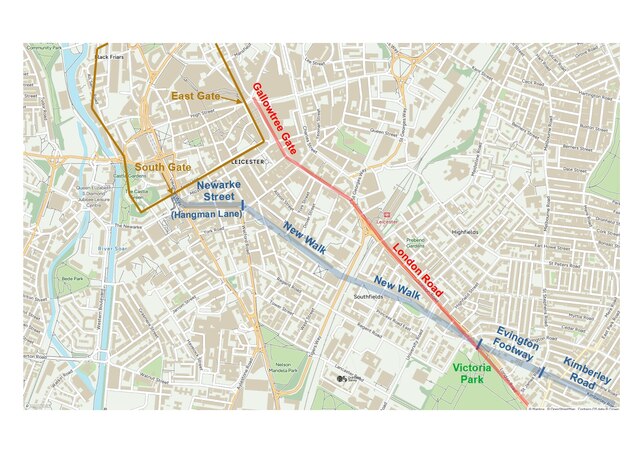
A map showing modern Leicester
The typical householder was a small-scale farmer, working on about thirty acres of land owned by a rich noble. The enslaved would also have been owned by a local noble, typically put to work as ploughmen.
We first see the name “Evington” written down in the middle of the 13th Century AD, when the parish had grown to include what is now North Evington and Evington Valley.
The latter both only became part of Leicester in 1892.