


Object of the Month: March 2026
Councillor Emily Comber Fortey
Published: 27 February 2026
- Object name: Councillor Emily Comber Fortey
- Material: Oil painting on canvas
- Date made: c.1940s
- Contributed by Dr Richard Finn OP, a Dominican Friar and historian at Blackfriars, Oxford
Emily C. Fortey – A Leicester Champion for the Poor and the Cause of Women
It was said even by her political opponents that Labour Councillor Emily C. Fortey (1866-1946), made ‘strenuous efforts to overthrow anything that she regarded as an instrument of oppression or which perpetuated ignorance, poverty and evil’. By 1896 one of Britain’s first women research chemists in Manchester and Bristol, Emily’s Catholic Faith led her to retrain in 1907-1908 at the London School of Sociology as a sanitary inspector and midwife committed to social action for the poor, especially women and girls in need of education.
Emily moved to Leicester late in 1908 to co-found with Miss Clare Ellerker an innovative community of lay women associated with the Dominican friars at Holy Cross. They lived and prayed together, and opened a small secondary school for girls, Corpus Christi School, first at West Walk and later New Walk. In 1911, Emily was elected to Leicester’s Board of Poor Law Guardians, the body which oversaw the city’s provision for the destitute poor in the Workhouse, at the North Evington Infirmary, or in the Children’s Homes, as well as the administration of so-called ‘outdoor relief’ – small sums given to supplement the income of the working poor and to support their families. Emily served tirelessly on the Board and its sub-committees for the next four years. She took a particular interest in the welfare and rights of the mentally disabled. A friend and ally of the Dominican preacher Fr Vincent McNabb, Emily also supported the campaign for women’s suffrage, founded the Leicester branch of the Catholic Women’s League, and served for several years on the Executive Board of the Catholic Social Guild.
In 1915, Emily left the community of Corpus Christi Sisters on New Walk and took charge of a Y.M.C.A. hostel for prostitutes and their babies at Havre. It was there she adopted the form of dress which appears in her portrait by Leicester artist Bernard Parker and which became her customary clothing. Strongly resembling the religious habit of a Catholic nun or sister, her plum-coloured tunic and veil were probably the uniform of a French lay Catholic group.
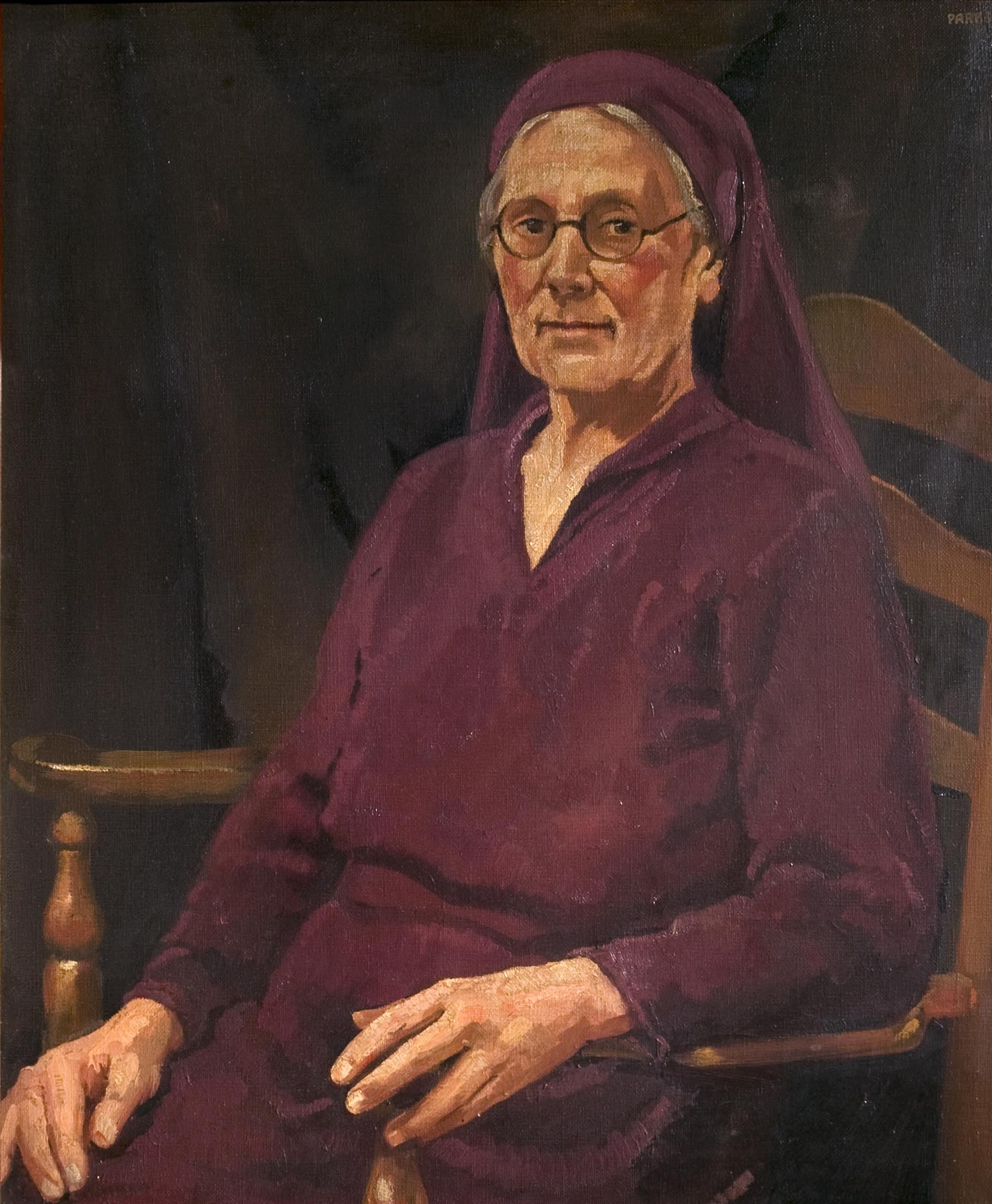
By 1922, however, she had returned to Leicester and re-joined the Board of Guardians. In 1923 she became only the second woman elected a Leicester City Councillor (and the first for Labour), and was named a Justice of the Peace in 1924. She campaigned for the employment of women police officers (opposed by the Chief Constable), for the retention of married women teachers (women previously expected to resign or be dismissed on marriage), for a living wage capable of supporting a family, for a greater number of free school meals, and for slum clearance. Her debating skills were honed in the Leicester Parliamentary Debating Society. By 1931 Emily was Vice-President of the Leicester Labour Party, President in 1932, and in 1934, now aged 68, was Chair of the Labour Group on the Council. Among other causes, she championed the expansion and re-building of the Domestic Science College at Knighton Fields House. At its opening in 1939, she spoke of ‘her perseverance throughout her life for the cause of women.’ Emily died still an active Councillor aged 80.
The Object of the Month can be seen in person throughout March 2026 at Leicester Museum & Art Gallery.