


Object of the Month: January 2026
Flower Painting
Published: 1 December 2025
- Watercolour
- 19th Century
- Credit line: Gift of Miss Ellis.
Chosen by Caitlin Price, Collections Access Officer
The Burgess Family
January’s Object of the Month was painted by Alfred Burgess (1806-1882) who was the Mayor of Leicester from 1864 to 1865. Alfred was the stereotype of an industrious, middle-class Victorian man; in addition to being an amateur painter and a successful hosiery and wool merchant, he was also the first treasurer of the Mechanics Institute (which provided Leicester with adult education) and he sat on the boards of the Mill Street British Schools, Ackworth School and the first Leicester School Board.[1] He was also a councillor for East St Margaret's Ward from 1855, a magistrate from 1857, an alderman from 1865 and, of course, mayor from 1864 to 1865.
Alfred came from a prominent Leicester family of Quakers. Quakers have been a part of Leicester since at least 1680 when they bought land on Dead Man’s Lane (now Soar Lane) for a meeting house and graveyard.[2] This would have been an early Quaker community as the movement had only emerged a few decades earlier in Lancashire. In 1876 the Leicester Quakers moved from Soar Lane to a meeting house on Prebend Street designed by the important Leicester architect – and member of the Burgess family – Edward Burgess (1850-1929).[3] Quakers believe in an inner light within everyone, and they consequently reject religious hierarchies and embrace pacifism and equality by promoting women’s rights, prisoner’s rights, the abolition of slavery and, more recently, protesting the climate crisis. Alfred Burgess clearly took his civil leadership duties seriously and he fought for equality through promoting education for all in Leicester.
The Burgess family led busy lives with philanthropic duties and varied professions. Alfred’s father, John Burgess, was an architect who designed municipal buildings and the family home, Wigston Grange, which was built on land which had been owned by the Burgesses since 1766.[4] Thomas Burgess (1799-1874), Alfred’s older brother, farmed the land around Wigston Grange. Alfred’s brother-in-law, Edward Shipley Ellis (1817-1879) – who had married Alfred’s younger sister, Emma Burgess (1809-1890) – was Chairman of the Midland Railway 1849-58, Mayor of Leicester in 1860 and helped to set up Leicester Museum, the free library, the Art School and the Permanent and Temperance Building Society.[5] Edward and Emma’s eldest son, John Edward Ellis (1841-1910), was the Liberal MP for Rushcliffe, Nottinghamshire, from 1885 until his death.[6]
In their leisure time, art was clearly important to many in the Burgess family as Leicester Museum and Art Gallery holds four works by Alfred Burgess, two sketched landscapes by his sister, Emma Ellis (née Burgess), 12 botanical watercolours by their niece, Gulielma Burgess (1840-1918) and one watercolour by a Frederick Burgess [Collections Spotlight - Gulielma Burgess Watercolours – Leicester Museums]. As lovely as these paintings are individually, they are just as important for the story they help to tell of a talented, hardworking Quaker family with strong Leicester roots.
[1] Emma Burgess (1809-1890) - Stoneygate Conservation Area Society
[2] Local History | Leicester Quaker Meeting
[3] Local History | Leicester Quaker Meeting
[4] https://www.wigstonhistoricalsociety.co.uk/Bulletin71.pdf
[5] Edward Shipley Ellis (1817–1879) | Art UK
[6] Emma Burgess (1809-1890) - Stoneygate Conservation Area Society
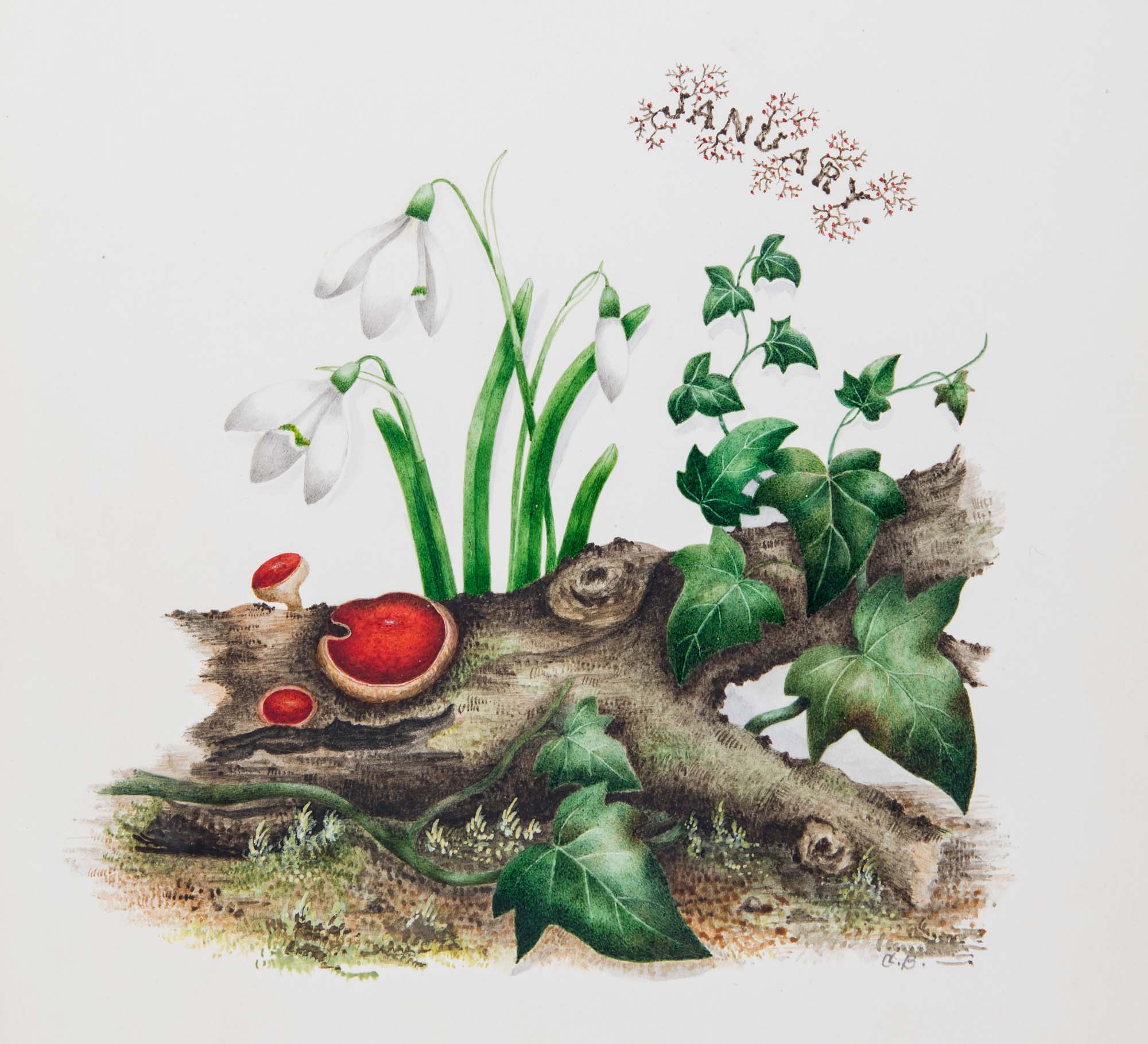
This painting depicts ivy, snowdrops and scarlet elf cup fungi. Scarlet elf cups break down dead wood, releasing the nutrients which help flowers such as snow drops to grow.
Leicester Museum & Art Gallery also hold landscapes and flower paintings by Alfred’s sister, Emma (1809 - 1890), and his niece, Gulielma (1840 - 1918).
The Object of the Month can be seen in person throughout January at Leicester Museum & Art Gallery.