


Responding to History: George Sfougaras and Dürer’s Knight, Death and the Devil
George Sfougaras’s 2018 artwork, held the city’s museum collection, responds to Albrecht Dürer’s iconic engraving Knight, Death, and the Devil.
For International Holocaust Memorial Day, Leicester Museums and Galleries invited George to revisit his work, share his reflections, and engage audiences through gallery talks and digital resources.
Published: 26 January 2026
“The lecture revisited my long engagement with Dürer’s Knight, Death and the Devil, not as a historical artefact sealed in the past, but as an image whose meanings have shifted dangerously across time.”
George Sfougaras
George’s 2018 piece responds to Dürer’s Knight, Death and the Devil, a Renaissance engraving renowned for its technical mastery and symbolic complexity. By reimagining the knight, Death, and the Devil, George reflects on the human condition, moral responsibility, and the impact of history on contemporary society.
“What initially drew me to the work was its technical mastery and moral gravity. What compelled me to return to it was its later appropriation by Nazi ideology, and the responsibility that creates for contemporary artists and viewers.”
George Sfougaras
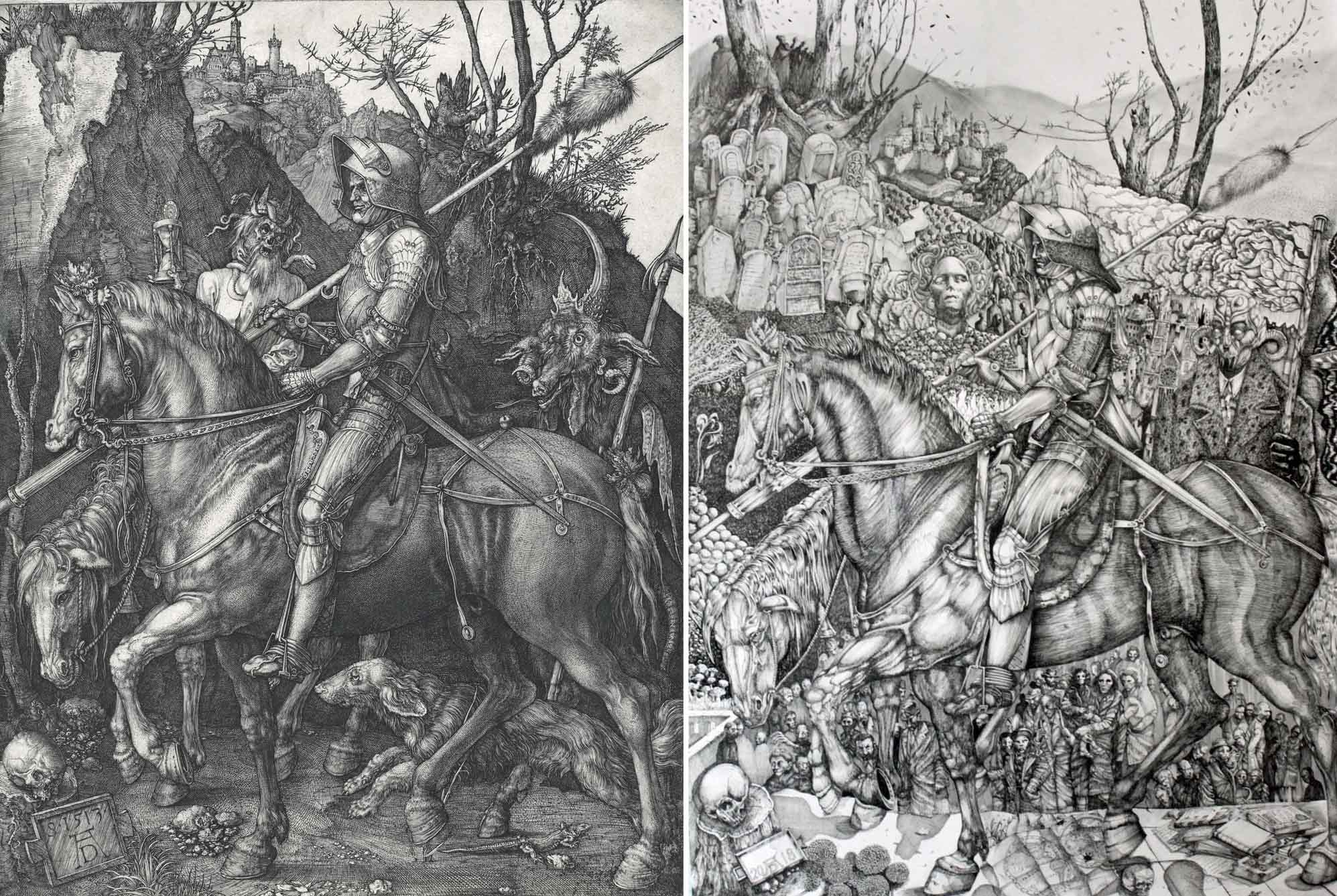
Left: Knight, Death, and the Devil by Albrecht Dürer. Right: The Knight, Death and the Devil by George Sfougaras
Dürer’s original engraving depicts a heavily armoured knight navigating a bleak landscape, accompanied by Death, a goat-headed Devil, and his faithful dog. George’s response reinterprets these figures to explore human resilience, suffering, and moral responsibility. Drawing on historical research, personal memory, and contemporary events, his work connects past and present, encouraging audiences to reflect on displacement, persecution, and the enduring lessons of history.
“In reworking the image, I wanted to confront how symbols of heroism, faith, and endurance can be weaponised, emptied of complexity, and turned towards exclusion and violence. The drawing became a way to think through displacement, moral blindness, and the persistence of human suffering across generations. Holocaust Memorial Day provides an essential context for this, not as an occasion for moral certainty, but as a reminder that vigilance, empathy, and ethical attention are never finished tasks.”
George Sfougaras
Displayed alongside German Expressionist works, the artwork became the focus for lectures, discussion, and printed resources. Visitors could engage directly with George’s interpretation and the symbolism of the piece, while AI-generated characterisations of the artist offered an interactive layer for reflection.
Two gallery talks hosted by George in February 2025 allowed the public to hear directly from the artist, with Q&A sessions offering further insight into his creative process and research.
“This work and my lecture were shaped by the conviction that remembrance must remain active. Silence, distortion, and indifference allow old images and ideas to return in new and dangerous forms. Art cannot resolve this alone, but it can insist on looking, questioning, and refusing easy consolations. The museum provides the conditions in which art can be encountered with time, care, and critical attention, allowing difficult histories to be examined rather than absorbed passively. In this setting, art works alongside education, dialogue, and lived experience to encourage sustained looking, reflection, and reframing. It is within this shared framework that understanding can deepen and the work of repair can take place.”
George Sfougaras
The project engaged audiences to consider complex themes such as Holocaust history, displacement, and resilience through immersive engagement. In doing so it demonstrated how contemporary artists can engage with challenging histories and symbolism, fostering reflection, dialogue, and ethical attention.
"The artwork is moving and thought-provoking. It was fascinating to listen to the artist talk about the process, the themes and the relevance for our world".
Museum visitor