


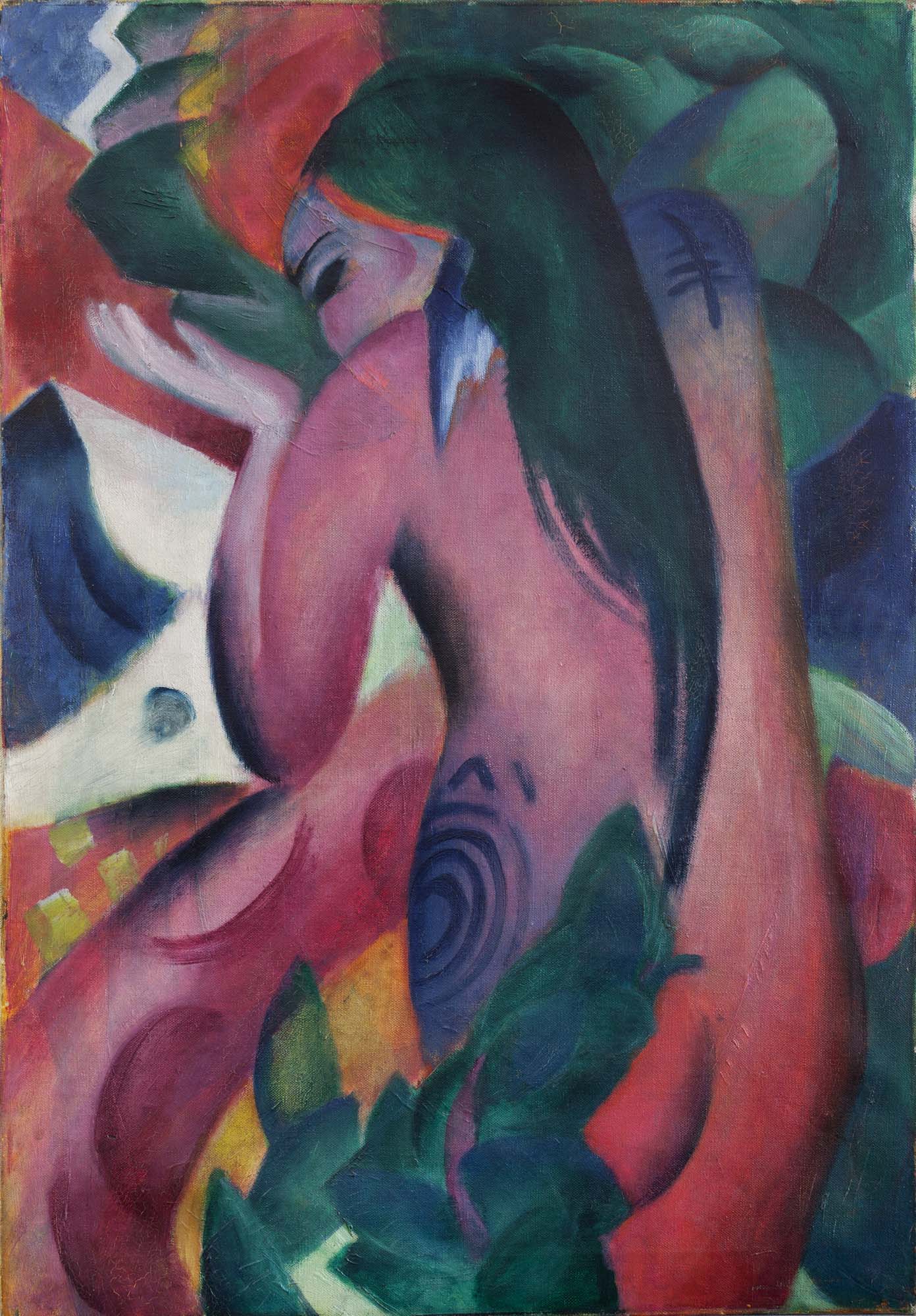
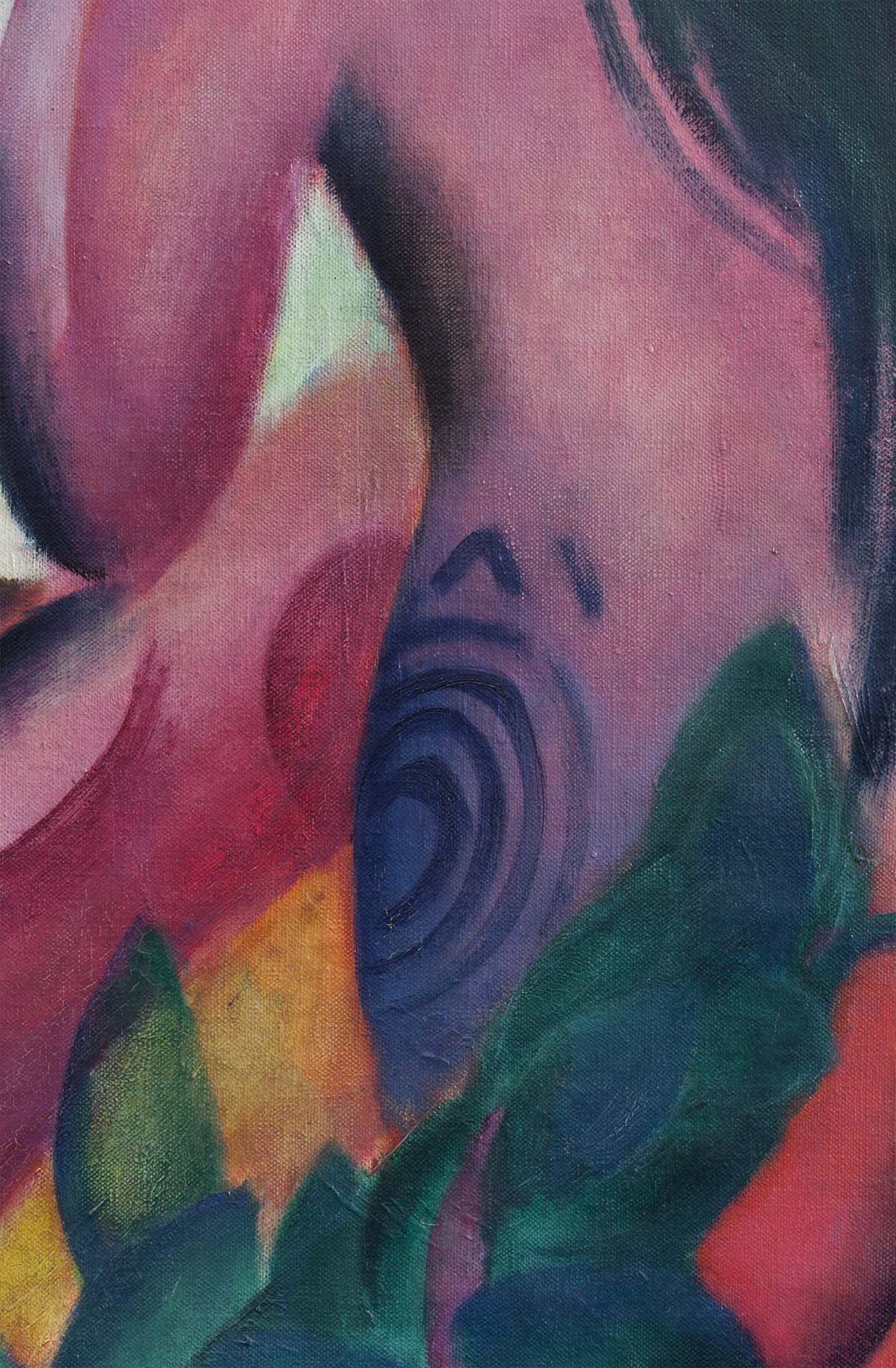
Red Woman was one of Marc's last paintings containing the human figure and reflects the humanistic idea of man's inter-relationship with nature. A female nude, untouched by the influence of civilisation, is harmoniously absorbed into a strangely patterned two-dimensional background.
Marc co-founded, with Kandinsky, the Blaue Reiter (Blue Rider) artists' group in Munich in 1911-12. One of the most powerful and original voices of German Expressionism, Marc's paintings depicted animals in spiritual harmony with their surroundings, using brilliant colours and increasingly abstract forms. Aged just 36, he was killed at Verdun in the First World War.
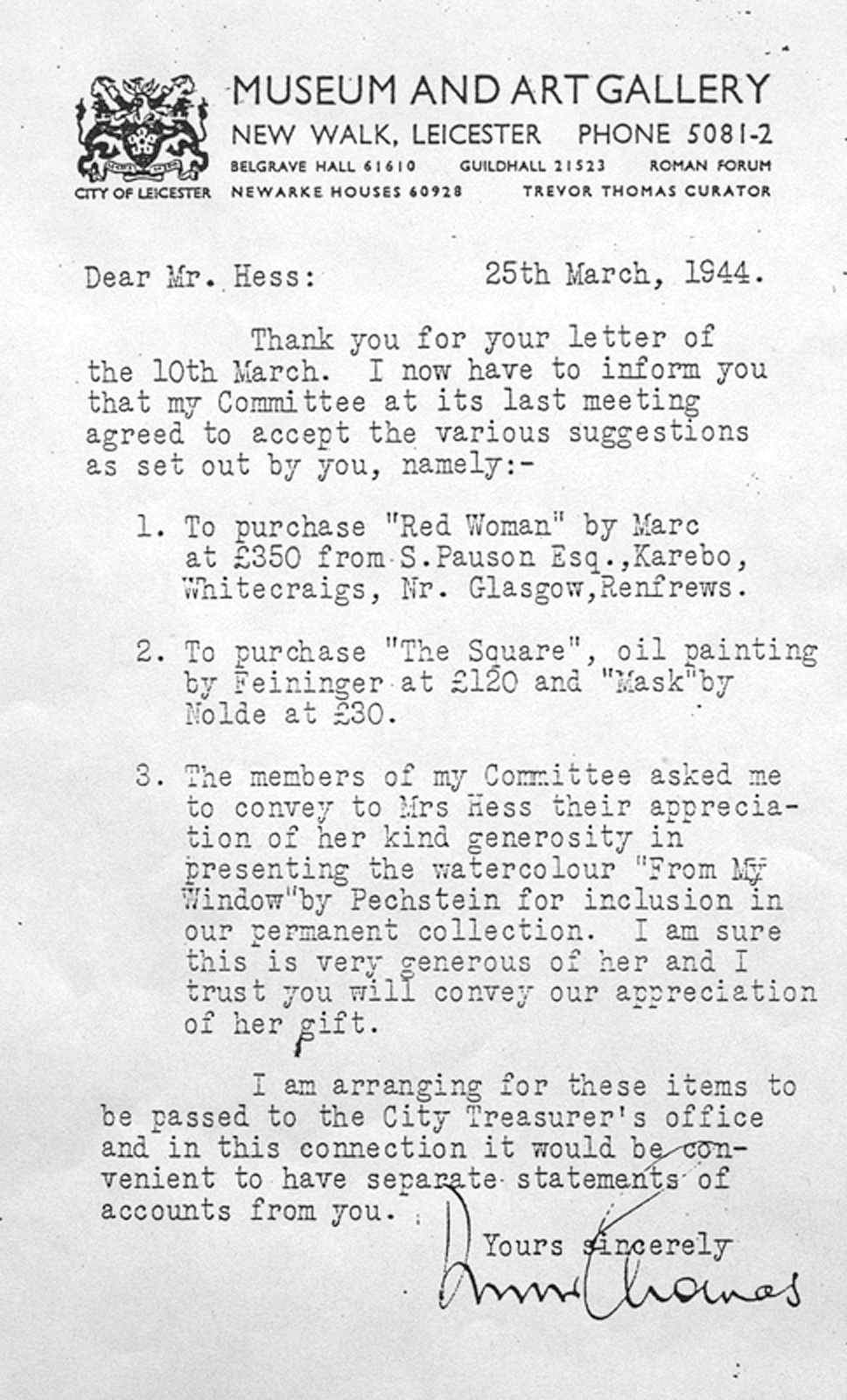
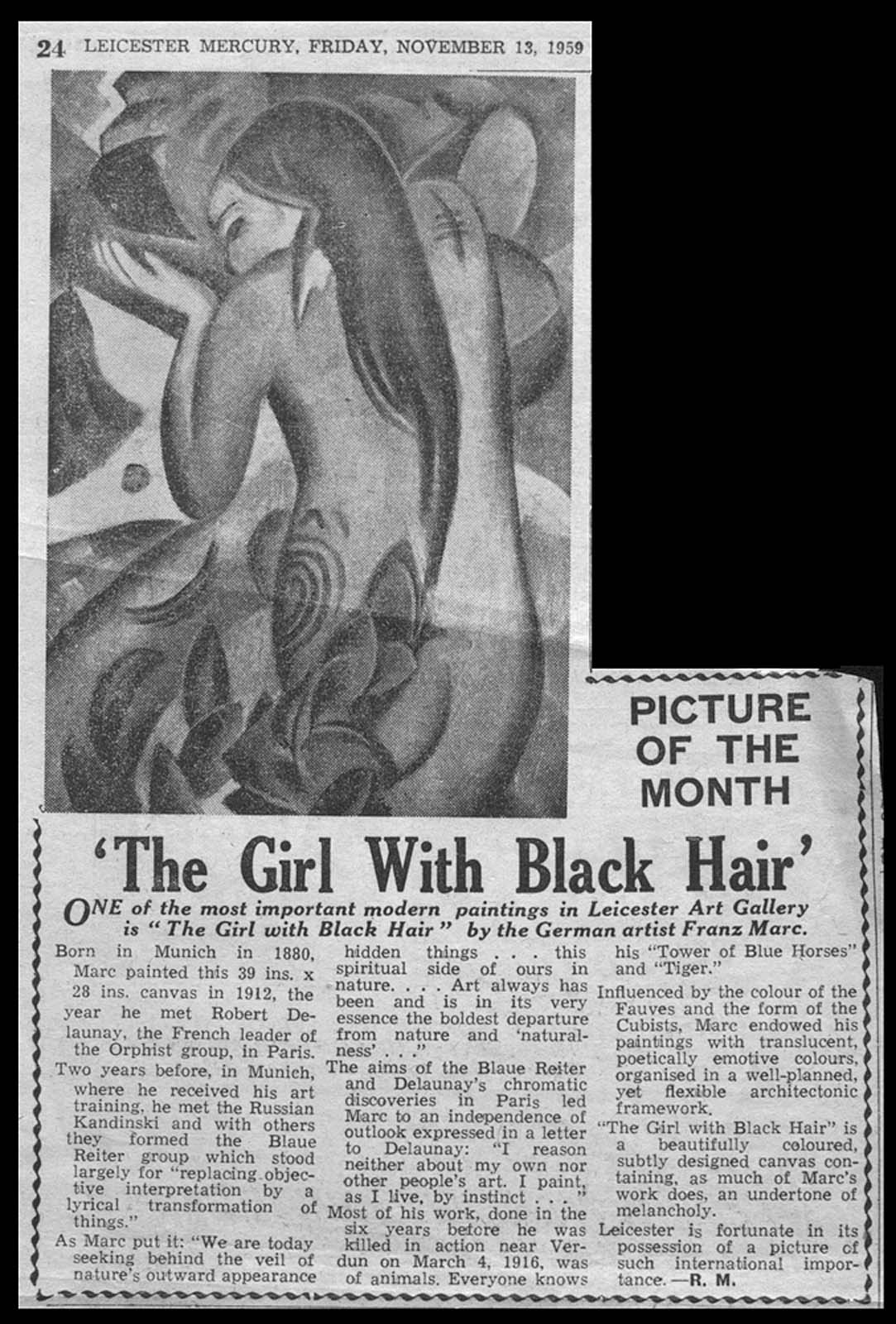
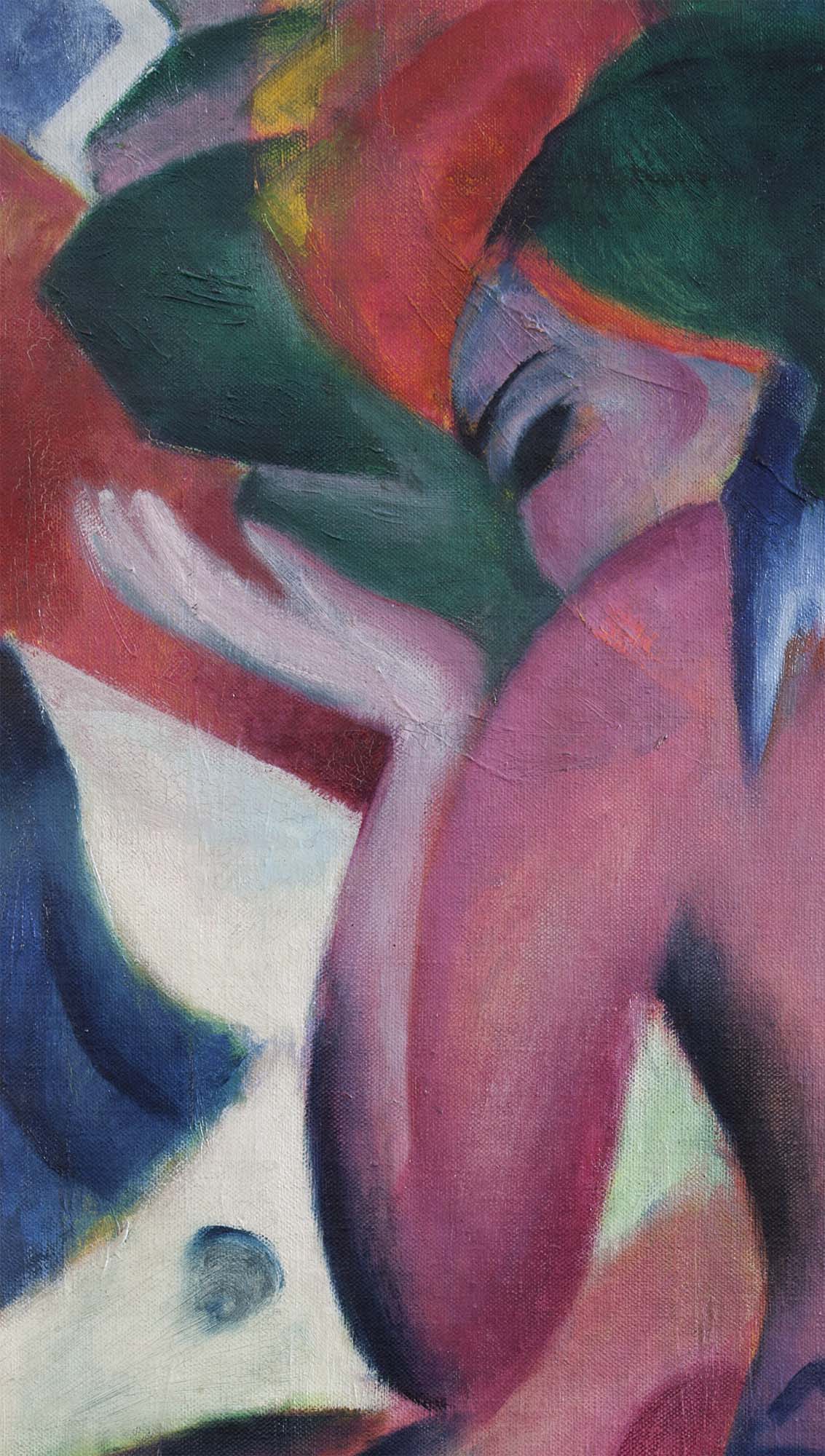
Explore the image gallery to see a 1944 letter sent to Mr Hess from Leicester Museums regarding the acquisition of The Red Woman and another artwork. Also shown is a 1959 Leicester Mercury article 'Picture of the Month' in which the article calls Red Woman 'The Girl With Black Hair'. You can see some close-up images of the Red Woman showing the different shapes and colours used in the work.
Red Woman Image Gallery
The Leicester Collection as a Key Asset in the Worldwide Understanding of German Expressionism
by Dr Jill Lloyd
Leicester City’s collection of German Expressionist Art plays a unique role in promoting the worldwide understanding of German Expressionism. Not only does it feature outstanding individual examples of German Expressionist art; it also includes an impressive range of artworks, in particular works on paper, which illuminate the history, background and development of the Expressionist movement.
Although certain artists (such as August Macke) and certain representative works, which are present in the most important international collections of German Expressionism (particularly in Germany and the United States), are missing from the Leicester collection, this weakness is compensated for by the inclusion of émigré artists and women artists whose works are difficult to find elsewhere. The so-called ‘lost generation’ of German and Austrian émigré artists - including Martin Bloch, Marie-Louise von Motesiczky, Ernst Neuschul and Margarete Klopfleisch - is particularly well represented in Leicester by works in the permanent collection and important loans that contribute to the collection’s unique character.
Moreover, although there are several museums in the United States that have benefited from donations by German émigré collectors, Leicester is the only museum in the United Kingdom that has such deep historical links with major émigré collectors of German Expressionism, such as Alfred, Tekla and Hans Hess, and Dr Rosa Schapire. From an international perspective, Leicester’s collection of German Expressionist art tells the story of émigré culture in the United Kingdom in a unique fashion, playing a vital role in our understanding of the reception and dissemination of the Expressionist movement, and preserving many works for posterity that might otherwise have fallen victim to the violent upheavals of twentieth-century history. Given the historical conflict between Germany and the United Kingdom during this period, the fact that a provincial English museum should have provided a haven for German Expressionist art is a remarkable phenomenon that deserves broader international recognition.
Since 1991 Leicester has also actively pursued the acquisition of ‘work by leading woman artists who have traditionally been under-represented in the documentation of developments at this time’ building on their small pre-existing collection of women artists such as Käthe Kollwitz and Emma Schlangenhausen. This aspect of the collection is of unique value in the worldwide understanding of German twentieth century art.
Although the discussion of key works that follows necessarily focuses on outstanding individual paintings and sculptures that reflect these defining aspects of the Leicester collection, it must be said that the large collection of prints and drawings is of considerable importance to the worldwide understanding of German Expressionism. In this instance, it is the collection of works on paper as a whole rather than individual key works that must be regarded as an important asset. The scope of the collection provides an overview of the Expressionist movement and its key influences, including, for example, works by Albrecht Dürer, Alfred Rethel, and artists of the Secessionist generation such as Max Liebermann, Max Slevogt and Ludwig von Hofmann, who introduced modernist art to Germany.
The leading Expressionist artists (including the Brücke artists Ernst Ludwig Kirchner, Erich Heckel, Max Pechstein, Otto Müller and Karl Schmidt-Rottluff, Blaue Reiter artists Wassily Kandinsky, Franz Marc, Heinrich Campendonk and Paul Klee, and Austrian Expressionists such as Alfred Kubin and Oskar Kokoschka), are all represented by drawings and prints – the latter medium having played a particularly important role in defining the identity of Expressionism and disseminating the movement. The collection of works on paper also includes an impressive range of independent artists associated with Expressionism such as Ernst Barlach, Käthe Kollwitz and Ludwig Meidner, and a few key examples of Weimar artists, including Max Beckmann, Otto Dix and George Grosz.
Combined with these high-profile names Leicester also possesses a unique collection of works on paper by lesser-known artists of the émigré generation, which is of particular significance for future researchers. This includes works by artists whose reputations have been more or less eclipsed by history: the collection of 34 watercolours, paintings and drawings by the Czech émigré artist Arnold Gerstl is a prime example of this aspect of the Leicester collection’s worldwide significance.
Dr Jill Lloyd has contributed extensive essays about a number of the key works and groups of works in the collection, shown alongside their entries in this catalogue, including: Lovis Corinth, Portrait of Carl Ludwig Elias, aged 7 ¼, 1899; Lyonel Feininger, Behind the Church, 1916; Arnold Gerstl, group of drawings, pastels, watercolours and oil paintings gifted by the artist’s family; Lotte Laserstein, Self-Portrait with a Cat, 1928; Franz Marc, Red Woman, 1912; Ludwig Meidner, Apocalyptic Vision, 1912; Gabriele Münter, Portrait of Anna Roslund, 1917; Ernst Neuschul, Messiah, 1918 and Black Mother c.1931; Emil Nolde, Head with red-black hair, c.1910; Max Pechstein, Nidden Coastline with Fishing Boats, 1909; Karl Scmidt-Rottluff, postcards, prints and watercolour donated by the estate of Rosa Margarete Klopfleisch (1911-82) Schapire; Renee Sintenis, The Athlete, 1924.